Weekends are a lot more pressure than weekdays. So much pressure to perform: Did you enjoy yourself? Did you have fun? Did you relax and recharge? Did you get ready for another week? Did you find some social connection? Did you find a girlfriend or life partner?
I can’t just lie in bed. I can’t just vegetate. I can’t just aimlessly walk around listening to things… That’s just not allowed! It is mandated: My free time must be spent pursuing progress.
Continuous, relentless progress. Sacrificing my mind, body, and soul, At the cold and unforgiving altar of advancement. I must develop new skills, I must build my muscles, I must open up my mind, I must hustle harder, More certificates, more reps, more momentum.
I must grind, Shear off all the jagged edges, Until I am nothing but a smooth, shredded, cerebral specimen. A dried, used-up husk, With a great job title, A big fancy car in a medium-large house, A woman that probably settled for me, An ungrateful kid or two.
So I’ll get back to it: Rubbing ointment into my hair, Trying to be the prized pig at the farmer’s market, Trying to speed-run my 20s in a few months, Just so I don’t miss out. Just so I have something to show for myself. Just so someone settles for me.
You see, I don’t get to relax. I can’t just be an unmarried 30-something, With no fancy job title, A small-car driving, entitled, non-productive, Squandered-potential man. I can’t wander and play and roam through life. I can’t do things on my time. That’s simply the wrong way!
This isn’t my time to spend, And this isn’t my life to live: It was simply loaned to me. I am indebted and indentured. I am here to perform my existence, Held up by invisible strings, Pushed around by all my masters.
So the sharks circle around me, So the lenders have come to collect, And so must the puppet show carry on, Every day of the week, And every weekend. Especially the weekend.
I never learned how to swim. And I never learned how to play chess. Now I’m useless in a zombie apocalypse: No strengths, no skills, and no smarts.
The world is ending. But the zombies aren’t yet at my door. So I think I’ll spend a little more time, Sitting around drinking beer.
They tried teaching me; The song and the dance, The ways of the world, The wrong and the right, But I just never learned.
I kept coloring outside the lines, Kept using the wrong colored crayon, Kept getting asked why I couldn’t follow instructions, All the while as I sat there wondering; Why they didn’t teach me how to color, And why they kept demanding I color the thing red.
They were the elders, though, they were in charge, And that was that. What did I know about success? What did I know about anything?
To them I simply didn’t have what it took: Not strong enough to swim against the current Not skilled enough to make it my way Not smart enough to meld passion and profession I could never be an iconoclast I was just an idiot
And so I was, Always the idiot son, Always the idiot brother, Always the idiot cousin…
But with so much potential! If only I’d learn: How to swim in my lane, And to play chess by the rules.
If only I’d defer and obey, I’d be adept, and I’d grasp so much! How to swerve and juke and jive, How to sing and dance and act, How to fake laugh, to secretly judge, to perpetually pretend…
Then I’d stop being such an idiot, And I’d unlock my inner potential: To be a zombie, Constantly chasing, To infect new bodies, Compulsively compelled To devour new brains.
Another woman, Another heartbreak, Another knife, Through my chest.
Every new knife, that’s pushed through, Opens up All the older wounds.
In these wounds, I look for answers, But I only ever find, Blood, and bile, and venom.
Smarter men, Luckier, or more fortunate, Have already found, The joys of settling, growing old and fat, impenetrable blubber skins, Impervious and puncture-proof.
I wonder why then, I keep letting women, Stick their knives into me.
I wonder why I let them leave me, Writhing on the ground.
I wonder why I lie there, Waiting, For the blood to clot, For a scab to form, Only to leap up, And stick my chest out, For another knife, Hoping it’s the last, But knowing it’s not.
The truth is: Between the old scabs, And new wounds, Is when I remember That I am alive.
One woman hated me: I wasn’t man enough. Another woman ignored me, I wasn’t good enough. Yet another left me- I wasn’t there enough I hope one day One will believe That I am just Enough
I remember Sitting outside college lecture halls, Penning pretentious poems.
I wrote about princesses in towers, Abstract visions, Conjured fantasies, Layers upon layers Of bullshit
I was afraid to say What I really felt, In the way That I really felt it.
Back then, Enslaved by emotions, Impotent Anger, Fervid Jealousy, Unrequited Love, Intense obsessions, I wanted the whole world, And I could have none of it.
As the years passed, I scratched, I clawed, And I carved out little slivers of life Wherever I called home.
The intensity mellowed out, The pretense dissolved, I cleaned up the bullshit, Or it was just Beaten out of me.
But My little slivers of life Were deemed inadequate And invalid.
They told me about All the things I didn’t have, And all the things I hadn’t done.
So I held my little slivers tightly against my chest, And went back to the world Of warped fantasies. Yet again I was enslaved, impotent, and fervid.
The love, Yet again unrequited The obsessions, Yet more intense.
The world in my dreams Now desolate and barren, The landscape scorched, The ground sowed with salt.
And I sit here, Halfway across the world, Poeting my thoughts. Unpretentious, raw, vulnerable, Not wanting to care, Not able to stop
Everything is just All too real There’s such a finality, An invisible deadline, For an invisible assignment, That’s woefully incomplete.
No more re-rolls of the dice, No more mulligans, And I’m back, Right where I was, When I sat outside lecture halls, Penning pretentious poems.
Let me know what you think about this video in the comments!
Video Transcript and Companion Post
When I made my first video three years ago, I started by saying, “I don’t know what I am doing”. Back then, I didn’t know about the visual medium. I remember being taken aback by how much people read into things- what was in the background, my facial expressions (you look tired/sick/frustrated), whether I had a 5 o’clock shadow, and of course, what I was wearing.
As time went on, I started making tweaks to those things- my backdrop, my expressions, and my appearance. And that last bit, while seemingly the simplest of the changes I made, helped me learn so much about myself.
You see, for the longest time, I insisted on a very simple, basic, and regimented style of clothing. One or two colors, little to no patterns or ornamentation, clothing that gets out of the way, that never makes any statements. That was just the way I preferred to dress for many years, and I didn’t think about why I was so adamant on sitting on the fence, neither dressing to impress nor to express.
So, when I decided to wear a Hawaiian shirt on a workday, I expected it to be a little joke, a surprise to my coworkers battling zoom fatigue whilst working from home in the middle of a global pandemic. I thought they’d laugh, think it was silly- maybe they’d think I was a weirdo.
But, they didn’t laugh at me. At best, I got some smiles, nods, a compliment here and there. That was a pleasant surprise, but it raised an important question- why did I think they would all laugh at me?
I pondered this answer for a bit. I got to thinking about the several years of my plain, minimal dressing sense, my insistence on not making any statements, and my cringing at bright colors or patterns. I thought about how it felt wearing a colorful Hawaiian shirt instead of a plain, single-color polo. I was pleasantly surprised at how good it felt to have a pop of color in an otherwise dull and drab existence that was full of sameness, especially in the times we live in.
I had a breakthrough when I went back to my past. I looked at pictures of me as a child. Of course, I didn’t buy my own clothes back then, but I saw I wore more colorful livelier clothing. So the question then became: what happened between my childhood and teenage or young adult years, that drastically changed my outlook towards how I presented myself?
After a lot of digging through memories, I found my answer. When I was a kid, maybe 5 or 6 years old, I decided to wear a blue beanie, or monkey cap, to school. It had tassels hanging off the sides of it. Blue is my favorite color, and I wanted to keep my ears warm in the winter, so I decided to put it on. I was warm, I was cozy, and I was feeling pretty good about myself until I walked to the bus stop. You see, kids can be cruel. The other kids at the bus stop definitely decided to be cruel to me that winter morning, when they all pointed and laughed at me in unison.
I learned a lot about people and society that day. I was ashamed, I was embarrassed, and most importantly, I learned a lesson- that it was time to grow up: no more being childish and silly. I had to look and act like a grownup now, and that meant I had to change how I presented myself.
I had relegated this memory to a dark corner of my mind, I’d never thought about it in many years. But I believe this was the event that had so many far-reaching effects. It changed how I saw myself and other people.
This was a huge realization because it helped me see that I was viewing all my experiences through that lens for so long. So many of my behaviors started making sense to me. My aversion to being made fun of. Taking things as a personal attack. Staying under the radar and refusing to get into any conflict or confrontation. My bad habit of putting myself down as a precautionary measure so others couldn’t do it to me first.
What is the name of this lens, the concept that lies at the root of it all? The inner child. The simplest, most commonly known, and yet most neglected of all things. This neglect is almost universal, and it affects our lives even when we’re adults. We ignore this inner child as much as we can, as we inhabit a cold, cruel world run by calculating adult minds, but this inner child has a habit of making itself known, a habit of overpowering the wills of even the most headstrong and stubborn individuals, in some situations.
In my case, it was my seemingly inexplicable defensiveness in the face of questioning and criticism. My desire to stay away from conflicts, arguments, and confrontations. And as I have talked about before, my overly simplistic dressing sense.
So how do I move forward, how do I deal with this? I started by looking at the lesson that incident taught me. By realizing that I was stifling my desires just to appease some invisible force. By thinking of the things that brought me joy that I abandoned. By realizing that living up to these expectations was an unnecessary weight that I was carrying around.
And yes, these expectations are a burden. My whole life, the constant feeling of unmet potential. If only I was taller, if only I lost some weight, if only I was an extrovert, if only I was popular and had many friends, if only I was top of my class in school and college, if only I was more successful by now, if only I had enjoyed my 20s more, if only, if only, if only.
My whole life I’ve been told to measure up to some ideal vision of what a man is supposed to be. Whether it be a rich and successful professional, or a womanizing Casanova. And so far, I’ve fallen short every single time. Not rich enough, not famous enough, didn’t have enough girlfriends… it’s the tremendous weight of unmet expectations, the guilt of this unmet potential hanging over my head.
I realized my dressing sense was just emblematic of the greater problem of trying to live up to some warped ideals that I thought I had to live up to. Of chasing all that I ought to have wanted, but all the while ignoring that which I really wanted. In this relentless desire to be accepted, to be acknowledged by the outside world, to ideally have praise and admiration, but at least to avoid being made fun of, I ignored this wounded, hurt, helpless part of my psyche, hoping it would just go away, hoping I would find a way to overpower it once and for all.
So where do I find myself, with all of these revelations? I think back to an entry I made in my journal, many years ago. In it, I wrote, “I keep looking outside of myself because when I look inside, there’s just this absolute child.”
This whole time I was trying to suppress my inner child, but now, I’ve decided to go the other way. To acknowledge and heal this part of myself. To express myself in ways I had not before, for fear of criticism or ridicule. Changing what I wear is just the start.
I hope this video helps you all embrace your own inner children instead of trying to escape them. Thanks for watching, and remember:
Don’t try to kill the part of yourself that you find cringeworthy. Kill the part of yourself that cringes.
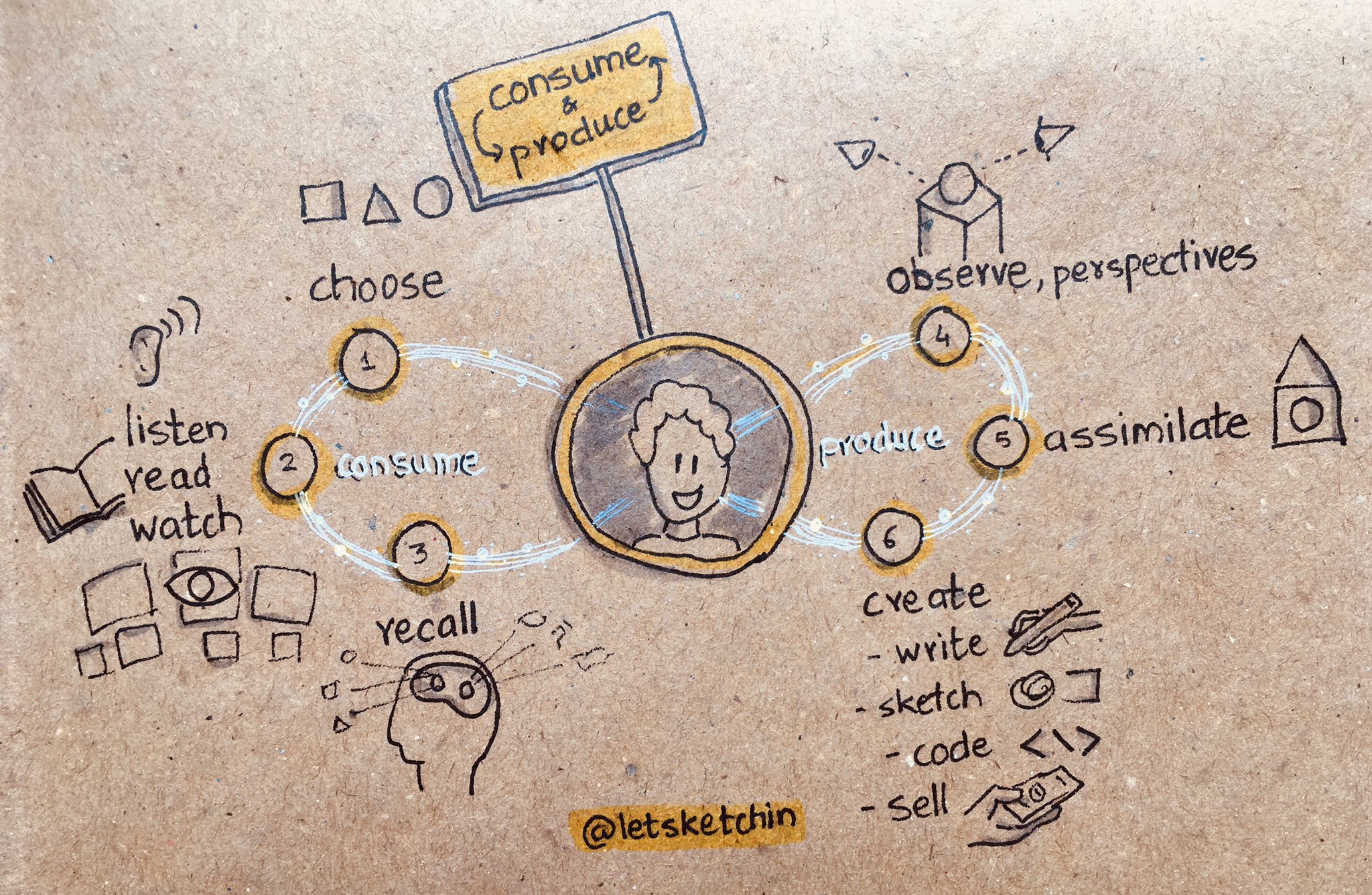
Now I know that simple graphics like this one get great traction on social media- because, well, you can mindlessly consume them, think about it for a moment or two, and then keep on scrolling.
I feel like this graphic puts things into a false dichotomy. There is the false notion that you can either be producing things or consuming them, with the implication that creating things is a better use of your time. Graphics like these don’t take into account activities where you’re neither producing nor consuming. I can pick out a few examples in this graphic that I don’t think fall into this dichotomy, take meditation for example- but I digress.
Here’s another graphic that gets so close and yet fails to move past this dichotomy. In this one, steps 3, 4, and 5 talk about recollection, observation, and assimilation, and go from assimilation to creation. While this may be a way of doing things, it over-simplifies the creative process in my opinion. So much of creation is re-doing and starting over. It fails to move beyond the dichotomy, the two-dimensional space, to consider the third dimension.
This graphic comes a little closer to how creativity works in my mind- but over-simplifies it.
The dimension these graphics fail to recognize is that of passivity and rumination. On the weekends, for example, I often find myself in a mental state where I am not producing or consuming anything, where I’m just ruminating on things, letting my mind wander as I do mundane tasks like cleaning my house. In those moments, I’m simply being, simply existing, simply letting my mind amble along imaginary fields. It is my way of rejuvenating and dealing with the stresses of daily life.
I find that it’s in these moments that creativity tends to strike me. In a way, the creative process is similar to those moments when you try to remember something and it’s at the tip of your tongue but you just can’t remember it. It’s only sometime later at some random instance when you’re not actively thinking about it that you remember.
It also reminds me of how Indian food tastes often tastes better a day after I’ve cooked it- because the flavors get more time to get to know each other when you just let them rest and give them time.
This discussion makes me think of the diminishing returns of constantly sacrificing your mind and body at the altar of progress. The constant framing of things as activities, something to actively do or to participate in, while demonizing passivity in all its forms. Not allowing yourself the adequate amount of time to process and work through things both physical and mental, well that just leads to diminishing returns.
I’ll give you yet another analogy. It’s like making sure your car gets regular oil changes. The oil’s there to lubricate the moving parts of the engine, and over time it accumulates all kinds of particles, that reduce its effectiveness. And if you delay it too long, you might start seeing larger and larger chunks of metal, and by that time you’ve probably already caused irreparable damage to the engine, reducing its overall life expectancy.
To summarize, there are two aspects at play:
One is allowing your mind to wander, to think of different things, to wander along all the grasslands and riverbanks and unknown paths to uncover new connections and interesting facets to things that you may not have uncovered if you kept walking along the same well-trodden path.
The other is that constantly trying to actively produce or even consume without giving your mind and body a rest, can lead to diminishing returns and eventual burnout.
I think Bill Watterson puts it perfectly:
For me, it’s been liberating to put myself in the mind of a fictitious six-year-old [Calvin] each day, and rediscover my own curiosity. I’ve been amazed at how one idea leads to others if I allow my mind to play and wander.
After years of rejecting modernity (using fitness trackers) and embracing tradition (being mindful of how my body feels and what it’s telling me) for my fitness journey, I finally caved into the siren call of technology last October and got myself a fitness band. I’d gotten into at-home workouts owing to the pandemic, and I needed something to keep me going, to hold me accountable, and to keep a record of my daily activities automatically.
I chose the Mi Band 5, because it was one of the most affordable options out there, and I wanted to test the waters before I committed to something more advanced. The reviews were pretty great, if not stellar. In terms of features, it offers the usual fare. It can track your steps, your sleep, your heart rate, and even your “stress level” using some sensors and math.
Setting up the device was easy enough. I was able to pair the band with my phone through that companion app. After setting it all up, I could see that it could count my steps, show me my heart rate, give me a “stress level” rating out of 100, and even measure how long I slept. So far so good. But you’ve read the title of this blog, and are probably wondering why I think I am being gaslit by technology.
It all began quite subtly, starting with the step counter. While the band tracks things passively, you can get it to actively monitor you by selecting one of several “workout” options. Selecting a workout allows you to record your progress and view summary stats after the workout ends. I started off by selecting the “walking” workout before going on walks. It works well enough for about 90% of the time, except for a weird quirk: sometimes the workout tracking pauses itself thinking I have stopped walking, while I am still walking. This has happened enough times for it to make me wonder how much of my walks are really recorded.
Now let’s move on to the sleep tracking. The sleep tracking gets a lot right. What it tells me about when I go to sleep, when I wake up, and how long I slept for is in line with my personal observations. It also shows me the different phases of sleep I went through in the night, and some “tips” to improve my sleep quality. One of the recurring tips it keeps showing me is that I should get more “deep sleep”. Now, I have always been a light sleeper, but I always felt like I got a good night’s sleep more often than not. Except now this fitness band comes along and tells me that I don’t get enough “deep” sleep even though I slept for a good 7 to 8 hours. Have I been wrong all along? Have I never truly had proper sleep in my entire life? Is that a problem I didn’t know I had? The gaslighting is taking hold now.
The tone of this messaging comes across as mocking, especially seeing how I do “exercise to keep fit”.
The biggest issue I have with this fitness tracker is how it utterly fails me if I try using it to track a workout that isn’t just walking. I have been working out at home for over a year and a half now. I alternate between HIIT (High-Intensity Interval Training) and Weightlifting. What I find when using the fitness band to track my heart rate during these types of workouts is a huge discrepancy between what the band reads, and what I am actually experiencing. I could be in the middle of a very intense session, and the heart rate monitor either completely freezes up, or says I am in a “relaxed mode”. This reflects in the final workout summary, where it shows a drastically different reading to the one I expect.
So how do I know that it’s the band that is wrong, and I’m not just making up these accusations of gaslighting against it? I wouldn’t have known if it hadn’t been for this YouTube video by the quantified scientist:
This is a YouTube channel run by a postdoctoral scientist in Vienna, Austria. He uses a rigorous methodology and reports on in-depth analyses that he conducts on wearable devices. It’s a unique and immensely valuable perspective on wearable technology in a space dominated by tech YouTubers and media outlets that go over the same talking points; basing their reviews on specifications and light real-world use.
For me, the two key takeaways from this review were:
The band recognizes deep sleep for the most part, but it records too little of it, when compared to a more advanced sleep tracker.
The band quite often misses increases in heart rate, and is not quite suitable for tracking weight lifting exercises, because it uses an optical heart rate sensor.
If I hadn’t seen this review, the discrepancy between what the tracker was telling me and my own personal observations would have kept me in a conflicted state of mind. Now that I do know the limitations of this technology, I have a couple of options before me. I could get better trackers (such as a chest strap to measure heart rate more accurately). Or, I could make do with the fact that “the quantified self” is nothing more than a silhouette, or a chalk outline on the pavement.
I’m sure getting better trackers will add some more details to the silhouette, that adding more things to measure will fill out that chalk outline with some more artistic shading. In the past year, I developed an adversarial relationship with the quantified self, because it didn’t record me well enough, and even if it could, it would always leave something out. Like an asymptote— it can come infinitesimally close to a complete picture, but it will be fully realized.
This gap between reality and the numbers presented to me by the tracker left me with nothing but dissatisfaction. What truly brought me back to being happy with myself is the “qualitative” aspect of things. Being cognizant of how I felt. I feel a lot better now than I used to feel 18 months ago. I feel more limber. I don’t constantly roll my shoulders anymore, nor do I constantly feel like my lower back is in a mildly annoying level of pain. I can lift slightly heavier weights than I could before. I can work out for longer. Muscle soreness doesn’t bother me as much as it used to. I feel more in control of my body, no longer are my body movements labored. My body feels more like a taut, perfectly tuned guitar string, unlike the loose, out of tune mess it was before.
The numbers, the scores, and the records are fine, but looking at them alone left me dissatisfied, because I knew not only how much wasn’t recorded, but also because I knew how much it couldn’t tell me about myself, even if it worked perfectly 100% of the time. This “qualified self” as I like to call it, is what brought me back to being happy with my progress and how far I have come.




 ShriViews