Routines and the Quantified Self

What is the “Quantified Self” ?

These days some of us or quite a few of us try to capture certain minute details about our daily lives in a digital format. We keep a track of the amount of steps we have taken, the amount of calories in the meals of the day, and so on. The aim here is to keep a track of these things so that we may reflect, analyze and learn about what is going on with ourselves, to eventually improve ourselves over time. This has become much easier due to smart devices and wearable technology. Each and every one of us is generating tremendous amounts of data about ourselves every single day. Systems like the Nike Fuel band, the FitBit and even Apple and Google’s fitness oriented application suites want to take advantage of this current trend.

At the heart of this new “Quantified Self” movement are tiny, inconspicuous sensors embedded in various devices, that help record and log surprisingly accurate and incredibly detailed information. These sensors, combined with ubiquitous computing that allows these numbers to be crunched and presented to the users in an easy to understand format, and social networks that allow the users to share and collaborate, form the core of the new “revolution” in health and wellness oriented experiences.

Although all of this is a great example of how the latest technology can be used for our benefit, the idea of the Quantified Self is not as completely new as one might think. We have been keeping track of ourselves in various ways long before the advent of miniaturized biometric sensors and portable smart devices. Certain things like keeping a track of spending, or stepping on a scale every morning, have been a part of our lives for quite a while now. What’s new is this increased need for self-knowledge, helped by the rich and detailed information that can be recorded about ourselves.

Of course, there are still a few issues with the whole Quantified Self movement. One of them is keeping the user engaged. These systems currently require the user to constantly monitor or observe the information daily or over time. This may lead to information overload, or confusing the user because of too much information. Another is keeping the user motivated and interested in the system. It is observed that after a while a lot of people tend to revert back to their old ways because they get bored or lose motivation, and their fitness trackers end up in a desk drawer.

Routines

One of the things I realized as I read and researched about human factors, is the importance of routines in our daily lives. Certain things we do, certain actions that we perform, are so familiar to us that we do not spend too many attentional resources to complete those actions. They become “routines”. We continue to follow those routines until something unusual happens.

To understand how we can make the above mentioned Quantified Self systems better, we need to understand how to design them better. That’s where the understanding of routines comes into the picture. If the systems become a part of our routine, completely non-intrusive without too many requirements on our attention, they might just become better experiences.

Today’s solutions

Designers have tried to work around the issue of keeping users motivated in the case of fitness tracking. Gamification, or adding game-like interactive elements such as competition with others in your social network, trophies or achievements for achieving goals, or Role-Playing Game like elements such as character creation and progression, have all been tried out. The problem here is that it lacks a universal appeal to people. Some people really like Gamification, and others can’t be bothered with it.

Other attempts at helping users maintain motivation have been actual monetary incentives, such as the “Pact” app that allows you to bet money on whether or not someone will complete their fitness goals, or the “PavLok”, a wearable device named after the Pavlov experiment, which literally gives the wearer an electric shock if he/she does not complete the pre-decided goal.

I believe that the solution lies in understanding how routines are created, maintained and modified. Creating a new routine or modifying an existing one is difficult compared to maintaining an existing one, because changing certain habits takes conscious effort and attention. It takes a few cycles of the routine to fully internalize the changes. If it is too difficult, the individual may revert back to old habits. Superficial motivation like Gamification may not provide enough incentive to the user, to completely change their routine.

What I feel would be the ideal experience:

One of the key aspects of the quantified self is the focus on the individual. Self improvement, and detailed information that is specific to the individual are the key points of this whole experience. Using pre-set goals like “10,000 steps a day” thus seems counter-intuitive to this point. If every person is different, then every person should have goals as per their requirement, or their capacity. That is where biometric sensors fall short, and human intervention provides a more suitable solution. Sometimes it’s better to jog or run until you can feel your legs tiring out, for example, rather than just stopping after 10,000 steps every time.

That is where I feel this system needs to improve not only simply recording detailed information, but also to help create routines, and help you find your own way of making the best use of the sensor data. Information that can help you improve upon your fitness by showing you how much you can do, and what you should do to push your limits. The user would know when they have done enough, when they can feel it in their own bodies, without the need of a 3D avatar of themselves telling them they did a good job.

Ubiquitous Computing- A Reflective Essay

Introduction

This course “Experience Design for Ubiquitous Computing” has had a focus on both the social and the technical aspects of Ubiquitous Computing, and how User Experiences can be designed keeping in mind all the myriad considerations. We began this course by looking at what was to be the lynchpin of the rest of our journey- Mark Weiser’s vision of the Ubiquitous Computing future [1]. We are arguably two thirds or so of the way there and his vision has materialized in some way albeit not exactly as he had envisioned. Now I will attempt to show my own vision of the future, for the next few years and even beyond.

Beyond the Western UbiComp Worldview

One of the key issues that was discussed time and time again was how Mark Weiser’s vision and UbiComp literature in general seemed to revolve around western culture. Of course, this was addressed by Dourish and Bell in their book [2], but there weren’t any examples. I will attempt to explain how UbiComp technology and design affects the part of the world not focused upon by current literature.

A vision for UbiComp – Convergence of Current and Future Technology

Mark Weiser showed us all his vision of the future in 1991[1]. He envisioned multiple portable computing devices in various form factors, being cheap enough so that people would have many of them at hand and could trade them around like hall passes. One of the foundations of this vision is Moore’s law, which recently completed 50 years of existence. Added to that is the proliferation of big data- tremendous amounts of user generated data being created, collected and now even harvested in some cases. There are also some technologies at the fringes of UbiComp, like augmented and virtual reality. Allow me to show you my vision of the future, with all these technologies taken into consideration.

Moore’s Law continues to hold true, and scientists eventually find a means to miniaturize computing capabilities to such a small scale that it can be measured in a Nano scale. These devices will drive the next generation of Ubiquitous Computing. Often referred to as “smart dust” [8], this concept has far reaching applications in the future. I can imagine smart dust being deployed in farmlands and agricultural fields, giving relaying soil nutrient and other such data to central governmental cloud services, from where farmers can get real time updates about their soil conditions whether they would need fertilizer, etc. This may ensure that farmers would not require to learn about complex systems for computing.

This brings us to the future of location and context awareness. [3, 5] One of the major changes that I see happening is the proliferation of augmented reality. I envision the use of this technology in a scenario that not many pay close attention to, the field of social networking and social media. If you observe what social media giants like Facebook are doing these days, you will observe a heightened interest in big data, and augmented and virtual reality. Facebook’s acquisition of Oculus and messaging platform Whatsapp is proof of this. In my opinion, Facebook’s mission for the future is to permeate into every aspect of an individual’s life. A person wakes up in the morning, his smart device by his side, a multitude of smart dust sensors scattered all around the environment. Wearable devices tell him he should get something to eat, because his blood sugar levels are quite low. His sleep pattern has been erratic over the past few weeks due to an upcoming work deadline, and he can see this through a head mounted display. Wherever he goes, the head mounted display [4] provides him up to date contextual data about the surroundings, his neighborhood, and allows him to take pictures simply by blinking his eyes. This technology brings forth an exponential increase in the amount of user generated data on social networks, with some people allowing social networks to showcase each and every minute by minute detail of their lives, and Facebook provides the facilities to do so. Increase in computing power allows people to live stream to hundreds or thousands of people at once through their phones or their wearables, be it talking to family, or a social gathering, or simply just entertaining personalities who use this as a means to reach out to their followers and perhaps gain some revenue through online payment mechanisms.

One of the major sectors to be influenced greatly by the proliferation of ubiquitous computing will be education. In ancient times, students would get individual attention from teachers.  This kind of teaching was reserved for the upper echelon of society of course. After the industrial revolution, the modern metaphors of classrooms with class teachers and tens if not hundreds of students being taught by one teacher became the norm. The internet brought about a revolution called e-learning. People of all ages could now access eBooks and video lectures from around the world. However, I feel that in the future, the confluence of contextual awareness and an exponential increase in the data available to people will bring about the next revolution in education. Children these days have access to smart devices with internet connections, and they are able to search for things simply by typing in queries in search engines. The rise of UbiComp based design will create a new kind of education system, which would be like a personalized digital teacher. Like Alexander the Great had a teacher and mentor in Aristotle, children will have at their disposal a digital teacher that will teach them exactly based on the child’s needs, based on data gathered through wearables, communication via voice and other input modalities, and various other means. Parents will have a control over and will be able to keep a track of their child’s progress, and will know what their child is learning. Technology, if influenced by the research about child psychology, will be able to cater to even special needs children through this new system. These days we see e-learning platforms like Lynda.com, but they are limited in their effectiveness, as they are not personalized for each and every individual student.

Of course the usual question arises, “What about privacy? Will people allow technology to permeate into their lives to this extent?” I believe so. As Langheinrich [6, 7] said, about 60-70% of people fall under the category of privacy pragmatics. As technology continues to permeate into our lives, and marketers continue to sell smart devices, wearables and even services to the consumers, it will create a level of dependency on these services that we would perhaps find hard to get out of. Just look at our increasing dependence on Google services, for example. Most consumers and small enterprises use Google services for email, cloud storage and even collaborative documents. As this dependence increases, we will slowly allow more and more technology to permeate into our very lives, and we will become more accepting of it as well. Just have a look at how instant messaging has changed family dynamics. I frequently chat with my family on instant messaging platforms like Whatsapp, which recently integrated a calling feature. An immediate result was me getting calls from my distant relatives, just because it was possible. This is an integration of various affordances into systems that increases adoption and acceptance. This also means there’s an increase in the “messiness” of the whole system. Free market competition means that cross-platform communication will probably never be as seamless as some people would like. This can be especially important if we move forward to a vision of connected homes, with the “internet of things” concept.

Another aspect that is important is the energy requirements for powering all these devices. Battery technology has not sufficiently advanced, and techniques like energy scavenging [10] have not yielded significant improvements. This could prove to be a major stumbling block for the proliferation of UbiComp.

Speaking of stumbling blocks, one of the concerns I have is whether all the questions that we have considered over the course of the semester will even be considered by creators of UbiComp systems going forward. I have observed that many of the case studies have been a post rationalization of systems by researchers, to look at what was right and what went wrong. Will the major players in UbiComp consider the socio-technical challenges while creating new systems? In the ethnography discussion [9] Dourish and Bell show in a way, that sometimes introducing technology into different scenarios needs some analysis. Sometimes, you need to know when not to introduce technology, rather than how to introduce new technology into each and every new niche or domain.

Conclusion:

Ubiquitous Computing seemed like a field that was myopic in the sense that it was so heavy on western influences. The key focus areas seemed to be sensors, person tracking and connected environments like the smart home. However, the more that I read into it, especially the two texts “Ubiquitous Computing Fundamentals” and “Divining a Digital Future” that not only showed the technical but the sociological considerations of this field. Being on the cutting edge of technology, UbiComp poses some novel questions and concerns that are not apparent at a surface level evaluation of the field. Designing systems for Ubiquitous Computing therefore should be in essence a multi-disciplinary approach.

References:

  1. Weiser, M. (1991).The computer for the 21st centuryScientific American 265 (3), 94–104.
  2. Dourish, P. & Bell, G. (2011). Contextualizing ubiquitous computing. In P. Dourish & G. Bell, Divining a Digital Future: Mess and Mythology in Ubiquitous Computing(pp. 9–43). Cambridge, MA: MIT Press.
  3. Estrin, D., Culler, D., Pister, K., & Sukhatme, G. (2002). Connecting the physical world with pervasive networksIEEE Pervasive Computing, 1(1), 59–69.
  4. Starner, T. (2013, April–June). Project Glass: An extension of the selfIEEE Pervasive Computing, 12 (2), 14–16.
  5. Dey, A.K. (2010). Context-aware computing(Chapter 8, pp. 321-352). In J. Krumm (Ed.), Ubiquitous Computing Fundamentals. Boca Raton, FL: Taylor & Francis/CRC Press.
  6. Langheinrich, M. (2010).Privacy in ubiquitous computing (Chapter 3, pp. 95–160). In J. Krumm (Ed.), Ubiquitous Computing Fundamentals. Boca Raton, FL: Taylor & Francis/CRC Press.
  7. Dourish, P. & Bell, G. (2011).Rethinking privacy. In P. Dourish & G. Bell, Divining a Digital Future: Mess and Mythology in Ubiquitous Computing (pp. 137-160). Cambridge, MA: MIT Press.
  8. Warneke, B., Last, M., Liebowitz, B., & Pister, K. S. (2001). Smart dust: Communicating with a cubic-millimeter computer.Computer34(1), 44-51.
  9. Dourish, P. & Bell, G. (2011).A role for ethnography: Methodology and theory. In P. Dourish & G. Bell, Divining a Digital Future: Mess and Mythology in Ubiquitous Computing (pp. 61–89). Cambridge, MA: MIT Press.
  10. Paradiso, J.A., & Starner, T. (2005).Energy scavenging for mobile and wireless electronicsIEEE Pervasive Computing, 4(1), 18–27. (doi)

FilmSite- Design by Contextual Inquiry

Description

The goal of this project was to design a system that could augment filmmaking capabilities with the help of Unmanned Aerial Vehicles (UAVs).

Requirements Gathering:

Our Project involved observing the setup, production, and post-production activities that take place during filmmaking projects. This included observing all activities related to videography, light and sound, Computer Graphics, and the synchronization between all these various aspects of the filmmaking project.

We observed the behaviors of the various people involved in the activities, their routines, and the procedures that were involved. We conducted interviews to gather more information about the various issues encountered while conducting activities pertaining to filmmaking. The constraints they had to work within were of importance to us. The observed environments consisted of film sets, office spaces, and Post Production facilities that had computer workstations.

Conceptualization through contextual models

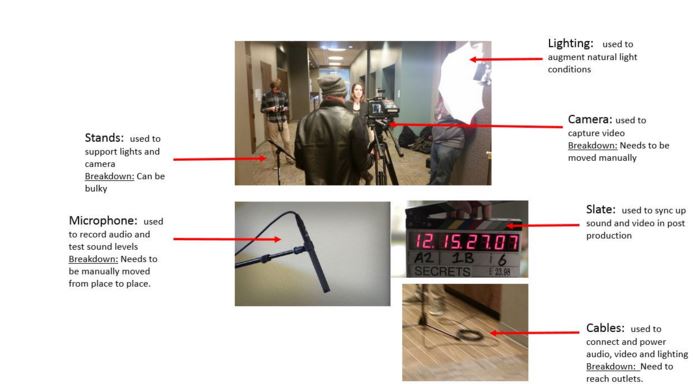
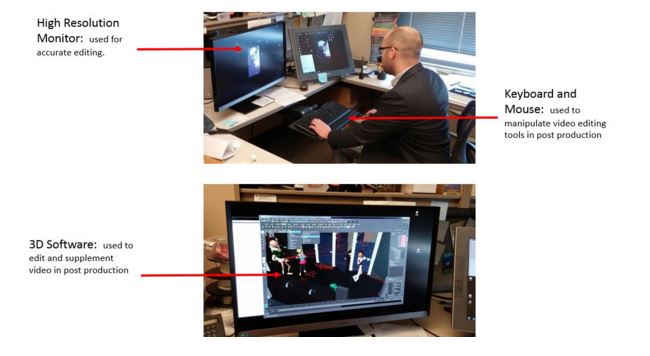
We took note of all the artifacts used, and the methods involved with using them. Contextual notes were taken, and diagrams were made, which were then consolidated. Based on the information gleaned from the aforementioned diagrams, we envisioned certain designs and a storyboard was created collaboratively.

Flow Model

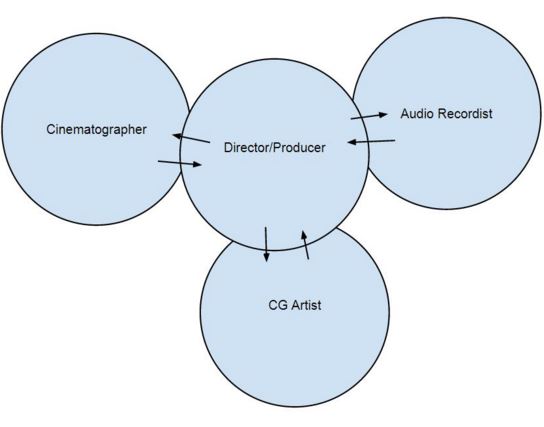
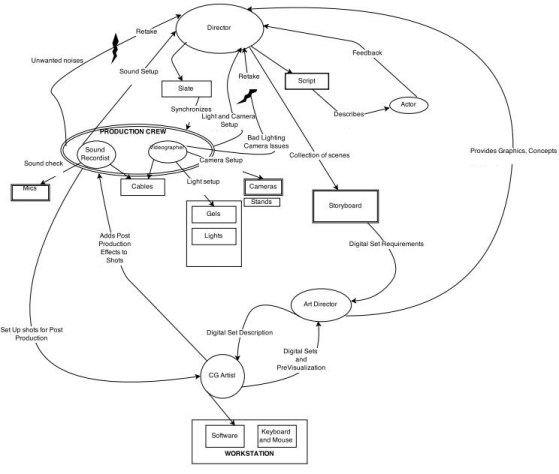
Below is a representation of the coordination, communication, interaction, roles, and responsibilities of the film crew.

H561FlowModel


Sequence Model

The step by step process of film production is described below in the sequence model. Intent, triggers, activities and breakdowns are discussed.

H561SeqModel

H561SeqModel2

Physical Model

Below is a model that represents the physical environment where the work tasks are accomplished within it.

H561PhyModel

Artifact Model

The artifact model gave us some insight into possible inefficiencies with using heavy equipment that requires power outlets and manpower in order to move. This gave us a little insight into how we could use drones in order to make some of these tasks less physically tedious and more efficient.

H561ArtifModel.JPG

H561ArtifModel2

Cultural Model

The cultural model reflects the close interaction among the film crew.

H561CulturalModel.JPG

Affinity Diagram

H561Affinity

Visioning and Storyboards

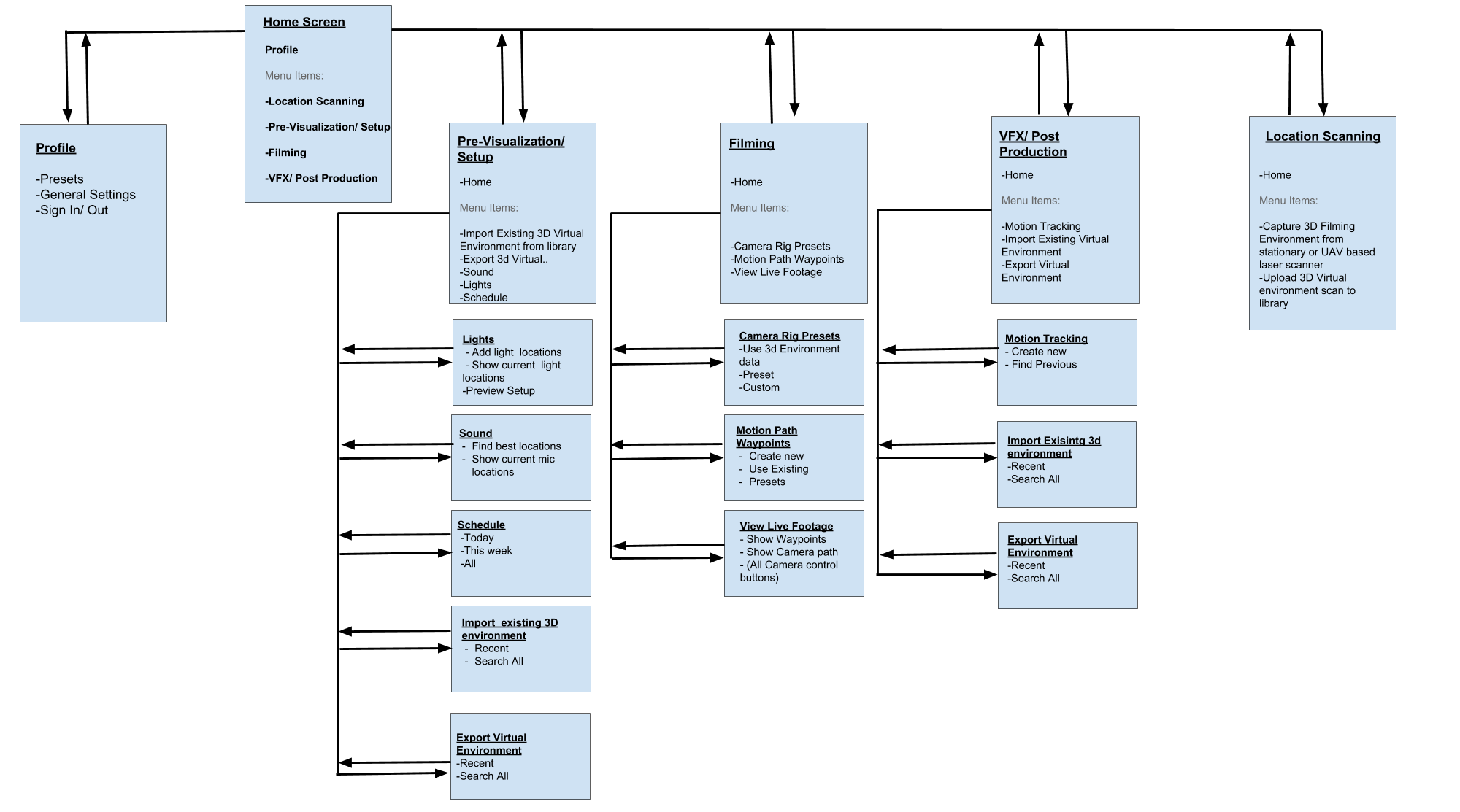
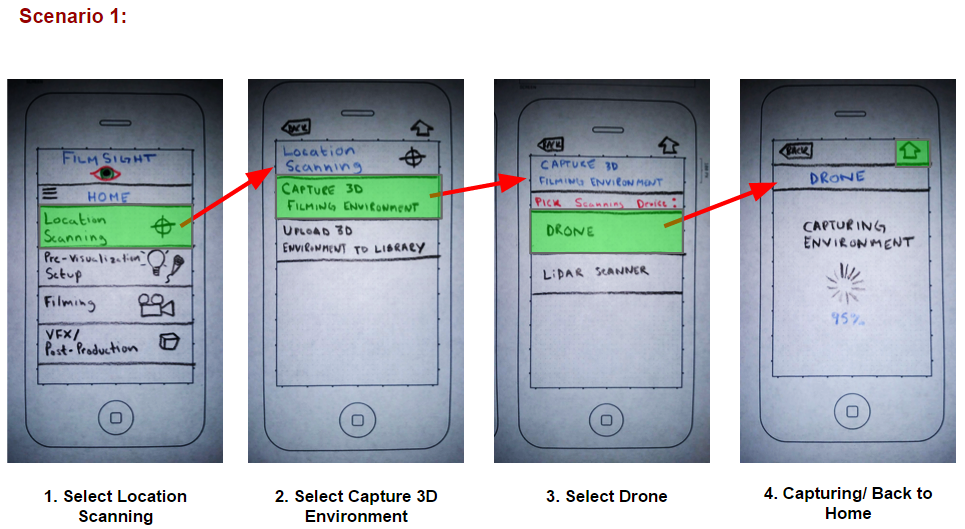
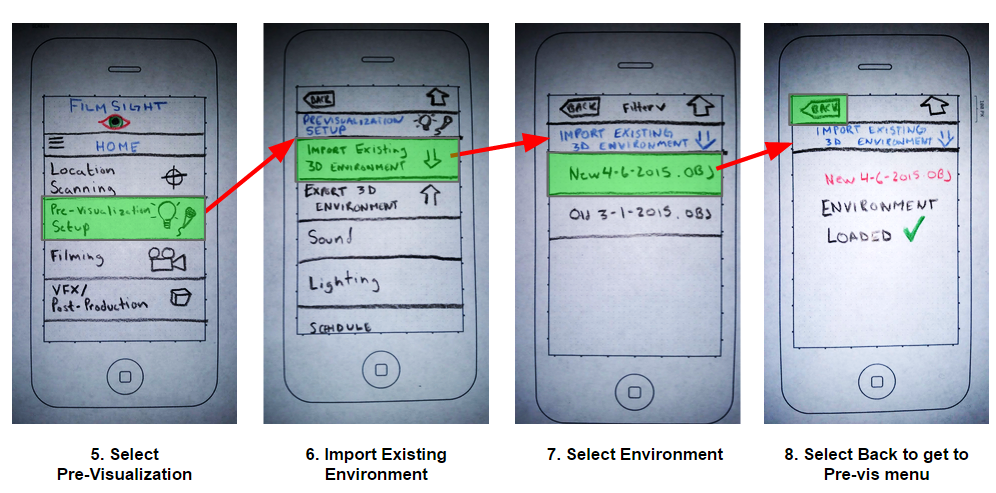
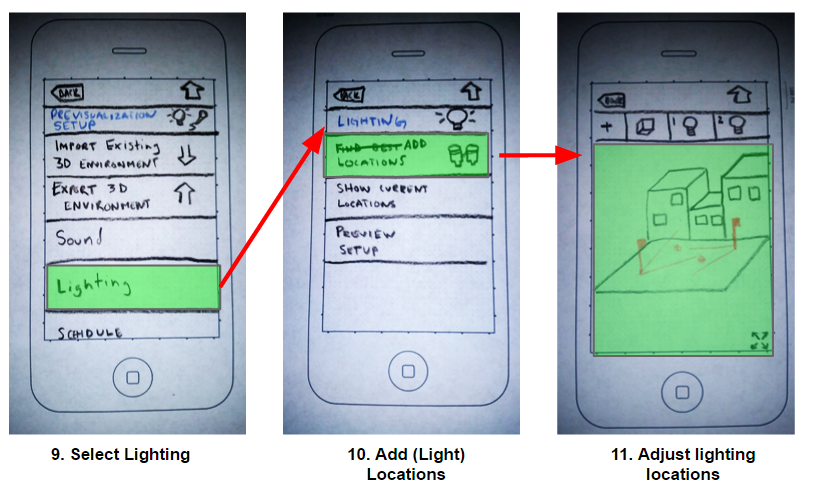
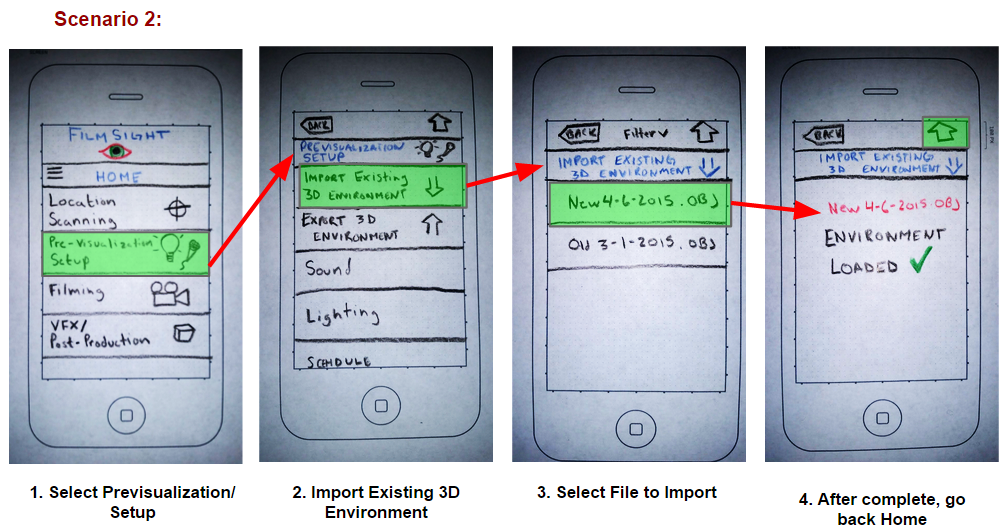
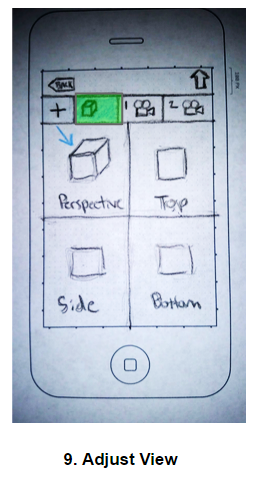
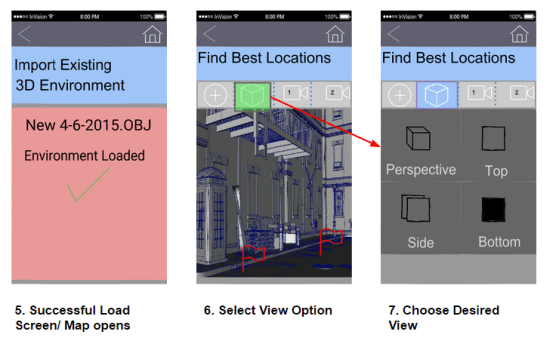
FilmSite is envisioned as an on-the-go visualization and film production tool that would allow directors, film crews, and post-production VFX designers to plan film scenes from any location, at any time that inspiration hit using a combination of real-world imagery and simple mock-ups. FilmSite will allow for scene and camera planning and instantaneous ability to share work through the application or by lending a mobile smartphone to another to view completed work.

H561Vision

The following storyboards illustrate scenarios of envisioned use:

H561Story1.PNG

H561Story2.PNG

H561Story3

User Environment Design

User Environment Design


Low Fidelity Prototype

H561LF1.png

H561LF2.png

H561LF3.png

H561LF4.png

H561LF5.png

H561LF6.png

High Fidelity Prototype

H561HF1

H561HF2


H561HF3.png

H561HF4

Interactive Prototype

http://invis.io/S82OVMYMY

Evaluation

Key Strengths:

  • Users appreciated the high-level intentions of the design idea
  • The 3D perspective in the pre-visualization was considered helpful
  • Ability to restrict the view to specific camera choices was extremely useful for multiple shot planning
  • Mobile platform is convenient for use when ideas come to mind, or you want to show ideas to colleagues by handing your phone to them

Key areas of Improvement:

  • Improved definition between sections that cater to different subsets of production (pre-production, production, and post-production)
  • Filming section is considered ambiguous, as  the entire application is designed for the process of filming
  • The exportation of the 3D environment in pre-visualization needs more clarity as to what it does
  • Show different angles of the 3D environment so perspectives can be seen within the prototype for better expression of the prototype’s intentions

FULL REPORT: You can view the full report, which includes all of the detailed information here: Full Reportbox_expand-512

Meandering through thoughts about “The Future”

Some pressing questions on my mind right now. In a world of fast paced technological advancement, in the face of said advancement, are we leaving some important things behind? Current or past systems that were in place offered something more than just what the raw numbers suggest. Some experiences that can’t or weren’t quantified in terms of statistics.

In our relentless quest towards moving “Upwards and Onward”, “Above and Beyond”, sometimes like race horses with blinders on, perhaps we are ignoring or disregarding all the other directions?

Research needs to be focused in order to get some sort of tangible and significant development, apparently. If it isn’t focused on something, it apparently isn’t worth going for.

Maybe I’m just looking at things with rose-tinted glasses. Of course, the human tendency towards romanticizing bygone eras and ways of life is well known. However, the opposite is also possible. “The future” is more alluring to some, and to reach it, they would abandon every single system, every artifact, every thought of the past and present. Futurists sometimes build extremely bizarre and extravagant visions for the future. Of course, realistically there are a lot more factors involved, which makes the actual future much more messy.

Just think about the visions of the future depicted in movies and popular culture just a few decades ago. They would have us travel in fast cars, wear outlandish clothes, abolish lawyers and what not. Granted that was all fiction and fantasy, and exaggeration is an important part of appealing to an audience when it comes to such creative endeavors.

On the other end of the spectrum there are the scores of people who paint a dystopian vision of the future. Nuclear Holocausts, cataclysms, et cetera.

Thinking of and discussing the future always takes a meandering path, but it always begins with “maybe it won’t be as bizarre as they think”. Either our minds will accept those now seemingly bizarre things as the norm. Or the current status quo in terms of society, economics and culture will remain the same. It also all depends upon how far into the future we are willing to think about.

No matter what happens, I’ll always say,

“The more things change, the more people change, the more they stay the same.”

Expectations

An important part of being mature seems to be to keep your expectations in check and not to get excitement in check. Everyone overstates the merits of whatever it is they’re hawking, and you should expect things not to live up to expectations. Honestly, no matter how much I try to be a cynic and look at the world this way, I think it’s impossible to fully embrace this as a way of life.

Nobody is born a cynic. It is an acquired mindset. Everybody knows what I’m talking about right now. Most people accept it. Everyone lies on different wavelengths of the spectrum of expectations. Everybody starts at the same point, though.

Now I’m a jaded person. I like to think that I can see through vicious marketing tactics. It makes me feel good when I can prove that a new thing isn’t actually new, and it’s a weird feeling when I’m successful because a part of me dies inside every time things fail to meet expectations. Unfairly raised expectations are often to blame, but people who raise them are to blame for that.

NewandImproved-450x260

“New and improved formula!” Alright, so what was the swill you were trying to sell me last year?

This jadedness is a shard of broken glass I see things through, sometimes it makes things clearer, but the jagged edges cut me and that feels terrible. Carrying it with me always is also a pain. Preemptive jadedness is a recently acquired habit for me though. New things don’t seem new when you’ve been observing the undulations of a particular industry with a microscope. I’m talking about the mobile tech industry in my case, but after a point this permeates to all aspects of existence.

Including people, and dealing with what we should expect from them. I’ll admit it, it’s impossible for me to expect nothing from people. Which is hypocritical because I don’t do much in terms of expectation fulfillment myself.

For four years as a student of Computer Engineering I was taught about limitations, constraints, and how to make things “fail gracefully” when they just couldn’t deal with expectations, in this case requests or user commands. As a blogger I read about marketers and how people overstate things, products and services. As an end user of said products and services I saw that everything had its drawbacks, and I had to pick the software or hardware that was the least terrible. There was no “best”, there was just varying degrees of terribleness.

As a Masters student, I have to ruminate endlessly about the possibilities of cutting edge technology. Cool as it may be, time and again I’m reminded that things are messy and complicated, and things are not what they seem. I digress.

Why do we expect? It’s because having a mental image of someone’s behavior is a part of human behavior. We have our judgments of people, and knowing how to “read people” has its advantages when dealing with matters pertaining to social life. Expecting in a way reduces the uncertainty of daily life and helps reduce mental load. After all, the human brain can’t deal with uncertainty very well. Overdoing the whole judgment thing has its drawbacks as well, it leads to a tunnel vision and we don’t account for certain possibilities.

Today, I had chocolate milk. Up until now, every single instance of me drinking chocolate milk has ended in disappointment, because when I was introduced to the idea of chocolate milk it was shown to me as a heavenly concoction made of molten chocolate, but whatever I had sampled was more milk than chocolate if anything. This was different. I had one sip and I felt something I had not felt in a very long time. Something had lived up to my innermost expectations. Not general expectations of a milky mediocre mess, but the expectations I had as a child. Molten ambrosia. Nothing less.

This made me think about expectations in general. Should we live with lowered or no expectations at all, for the off chance of something being slightly less terrible than what other things are? Should we just have normal expectations, only for them to not be met and then going through a coping mechanism of regret and cynicism?

Parallels

Parallels. The feeling of knowing something all too well. Deja Vu? No, it’s not that intense. It’s more like a reboot, creative re-visualization, an adaptation, yes. Will I need to do the same things that I had to do before? Maybe. I haven’t given myself that much of a chance. The problem is there’s always an urgency involved with everything surrounding this, resolve immediately, or else. If I let it tide over me, if I let it consume me, I will not be the same person.

Am I obsessed? I like to think that I am not. It’s just that I’m totally out of fuel, out of patience and out of time as well. Luck and Karma are relative things that are secondary to these key primary factors that my state of mind depends upon.

Maybe there’s something very primal about drawing parallels. Adding context to certain actions based on experiences. Everyone draws parallels to make sense of something, or to see a thing in a new light. The light of familiarity. The brain cannot handle uncertainty, the nebulous mass of perceptions and memories that you might have.

The problem with parallels is that you really can’t go to the root of the problem or issue that’s plaguing you. The lines extend without intersecting, forever. Things are similar but not the same, separated by time. This means that you have to come up with new ways to combat the afflictions laid upon you.

Sometimes the parallels don’t even help. They are often misinterpretations, and one can waste a lot of time thinking about parallels that don’t actually exist.

Boiling Point

Things tend to pan out in ways that are different than you wanted, you would have liked, than what would have pleased you. That’s why you say to yourself, you try to say that it’s all for the best, that you didn’t want it anyway. Maybe you let yourself marinate in seething rage. Maybe it burns you slowly. Maybe it’s a maggot that eats you from inside. Of course it’s all in your head. Of course they aren’t kicking you when you’re down. Of course, you’re not different. You’re just ignored. Which is both a great and a terrible thing.

The act will never end. They will play, and they would like you to play, and to be played. There is nothing else. The well of wishes remains lonely, nobody peers into it, not even to throw a stray coin into it, let alone peering into the dark water and ponder upon its silence.

All apologies are fake.

Sometimes you can’t pinpoint why you hate certain people. It’s because they aren’t easy to vilify at times; perhaps their positivity isn’t directed towards you, it’s always pointed somewhere else, (someone else). In the heart of your heart, you don’t want them to be happy. You want you to be happy. You think about yourself, just like they do. Except, they call you out for doing it so openly. You’ve got to pretend to be nice and to like people, passive aggression being some sort of power move to assert your mental dominance and mental superiority. Maybe it’s an inferiority complex, you’re not the best at anything anymore. “I’m the worst at what I do best” and all that, except I don’t feel blessed at all. Maybe I should embrace my mediocrity and just live with it.

But maybe- I should just live in constant defiance, reclusive and ready for a fight that doesn’t actually exist. It’s easy to be a superhero because the supervillain is just completely evil. Also supervillains tend to be quite obvious and they are written. Written to be defeated. Obvious in their actions. Flawed to the point of weakness. Real evil conceals itself. Hides in plain sight, behind the most beautiful, most kind faces. You cannot defeat it.

I try to keep my guard up, to shield myself from my propensity to be consumed by my emotions. But I know I love it as well. I’m obsessive, I’m perhaps compulsive. The same person as I always was. In a setting that’s not good for my afflictions. People like me should not be left alone, I guess. I’m like a novice vigilante who charges into things and then gets impaled by a hail of bullets arrows and rusty knives. The wounds heal, but the infections linger on inside me. Multiplying, growing more and more powerful.

One day I’ll accost my demons head on. One day I’ll let them take a chunk out of me, and I’ll feel light and empty, ready to be filled with more of the same. And it’ll all happen again. A man in perpetual wait, waiting for his boiling point.


Usability Evaluation – Craigslist

Description

An expert usability evaluation I conducted as a part of a team project, for a class titled “Usability Evaluative Methods”. We conducted heuristic analyses and cognitive walkthroughs as a part of the formative evaluation, after which we conducted a usability test.

The test was a comparative study of Craigslist and a competing website called Oodle.com. There were 5 tasks per website. Half of the participants started with Craigslist, and the other half started with Oodle, so practice effects were taken care of. The participants were asked questions in the form of a semi-structured interview at the beginning of the test, and were asked to fill out a post-test questionnaire consisting of a modified System Usability Scale (SUS), and a unique card-sorting session which helped us glean information about the participants’ thought process.

Formative Study- Heuristic Analysis and Cognitive Walkthrough

We conducted heuristic analyses and cognitive walkthroughs individually and combined our findings. Some of them were:

Craigslist Home page

  • The lack of categories order, Boring design.
  • Difficulties in changing location.
  • The search filters are not working.

Account page

  • Difficulty in finding the “create a post” option once logged in to account.
  • Difficulty in navigating away from the accounts page.

Search Results

  • Search filters do not work.
  • Search alert function not clearly explained.

Summative Study- Usability Testing

In order to diagnose areas of improvements, we tested Craigslist.org against a similar site, Oodle.com. We compared these findings with the usability issues we identified in our expert review. Some of our expert review findings were confirmed by the user testing and new issues were revealed as well. There were two evaluators present during each user testing session. One would facilitate the test. The other would observe. A total of 8 user testing sessions were conducted.

Task Descriptions

Each session included the following tasks for Craigslist.org:

  • Logging in to User Account
  • Post a Listing
  • Add an Image to a Posting
  • Search for an Apartment to Rent
  • Save a Search

Each session included the following tasks for Oodle.com:

  • Logging in to User Account
  • Post a Listing
  • Add an Image to a Posting
  • Search for an Apartment to Rent
  • Mark a Listings as Favorite


Summary of Findings

Here are a few graphs showing a summary of our findings:

CraigslistSUS

CraigslistTaskRating.JPG

CraigslistTimeOnTask.JPG


General Recommendations:

Here are some recommendations that we found as a result of our card sorting exercise:

  • Adding the text box where user can “Search by Location” that is used on several other classifieds websites
  • Adding notification about waiting time for processing new listing after the users had posted their new products. Currently website doesn’t notify its users that the new postings take about 20 minutes before they can be viewed by other customers.
  • Adding product location distance that shows users how far they will have to travel in order to pick up their purchase. Few websites, together with Google maps, are already using this feature.

Other Recommendations:

  • Restrained social media integration
  • Clearly labeled icons

FULL REPORT: You can view the full report, which includes all of the detailed information here: Full Reportbox_expand-512

Smartphone Rant- the Hype Disappointment Cycle Continues

The annual hype-disappointment routine that is the smartphone release cycle continues to churn, and since the last time I talked about that, things are pretty much the same. Phones, smartphones, phablets, ginormo-screen pocket bursting behemoths roam the landscape unchallenged. Kind of like dinosaurs, in that way. Way too big, and will probably continue to rule the landscape until there’s come major cataclysm. In that respect, I sincerely hope we’re living in the cretaceous period of the dino-phones.

Why the sudden hate towards screen size accretion? Well, I don’t explicitly hate the things, I’m just increasingly annoyed by them. Hundreds of tech blogs have opined about the rise in popularity of these five point something plus inch screen devices, their perceived usefulness, their actual usefulness, phrases like one handed usability and screen real estate are being thrown around like stale confetti. These devices are popular, people buy them, other people wonder why, and some write about it too. With long standing opposers of this trend (apple) now diving headlong into this whirlpool, the soft chorus of voices that ask when we will see the end of this phase seems to be getting softer.

After looking into why people seem to like large screen phones, I can only find one proper answer. Apparently, there are lot of people out there who want just one device, rather than multiple ones. Phablets seem to satisfy this need. But do they really? Yes, watching movies, and consuming media in general seems to be better suited to them, but apart from that, there really doesn’t seem to be any added value here, at least to me. No, Samsung’s “Multi-Window” and the other implementations of multi-tasking are NOT useful. First of all, the number of apps that support this functionality is limited, and secondly it isn’t really the most fluid experience one can have. I’d personally rather switch between apps rather than try to fit multiple windows on a screen and try to work as they glitch out, jump around and basically don’t work to the level of desktop applications.

Speaking of one handed usability, these phones sometimes come with accessibility features that help users use their phablets with one hand easily. So, they need help to use their device, with the help of a special feature. When you need a special way to be able to use your device despite its size, you’re not having a very good user experience, in my opinion. “Reachability mode” and all these software tricks are stop-gap solutions at best. I cringe when I see the unused space that’s left when these accessibility modes are used. It looks ridiculous, and the whole “bigger screen adds more value” argument seems to fall apart.

All these gripes with the current state of mobile phone screen sizes intensified when I began to think of what my next phone should be. My phone has served me well for the past three years, and despite having a good developer support in terms of custom ROMs, it’s on its last legs. What phone do I get? One of my best bets is probably the OnePlus One. Specifications, price, it’s got it all, hasn’t it?  Except it doesn’t have it all. Whenever I look at the device, and when I saw it in the flesh, I simply couldn’t shake off the feeling of it being a “high quality prototype”. It is version 1.0 of a design, a platform, whatever you’d want to call it, and the subsequent versions will be better than this one, or at least they should be. Now, what does that make the users of the current device? Glorified beta testers.

How about the Z3? It looks and feels premium too doesn’t it? Oh, and why not the Z3 compact? It’s the perfect device for all my qualms! Just one thing- the UI is uninspired, and if I try to rectify that by rooting and flashing custom ROMs, well, that would mean the camera experience would take a hit. I won’t be able to use certain features of the camera due to DRM. And I’m not going to stay on the stock UI, especially when Sony tries so hard to sell me their stuff at every given opportunity when I use it.

How about the Galaxy S5? Although I don’t like to admit it, that is probably one of my safest bets right now. I can get rid of TouchWiz, and there are quite a few custom ROMs to choose from. Maybe. How about HTC devices? The latest iteration of the sense UI is pretty good, right? Well, I guess I can’t argue with that either.

There are many, many devices and OEMs I haven’t listed here, and they all feature in my thought process in some way or the other. Three’s just one thing. Have you ever bought a new thing that didn’t feel new? That’s the most important thing that’s holding me back. No matter what I end up getting, it won’t replicate the experience that I had the last time, the wonder, the amazement, the delight. It’s just the same things with new coats of paint, and more unwieldy than the previous thing.

Thoughts after a week in ‘Murica

When life’s too comfortable, and there’s nothing that compels me to write, it’s a bit unsettling.

These smiling, cheerful facades hide a million prejudices. The idea of being a second class citizen plays in my mind constantly. Being compelled or being thrown into social situations, I have to do things, to put it bluntly, in ways I’m not used to. A weird and uncomfortable mix of apathy and cheerfulness is what I find here. Sometimes I feel like it’s better to more careful and simply assume all of it is fake. However, too much of this might even lead to being boxed in, the so called “ghetto mentality” that many seem to accuse Indians like me of having.

I want to come across as a brooding, serious thinker. I’m afraid I’m coming across as a bumbling idiot.

Although me coming across as a bumbling idiot may be hyperbole, it is a possibility.

Being inaudible and incoherent has been an issue I’ve been dealing with for a long time. It isn’t debilitating but it’s very visible to me. I won’t fake an accent and whether that’s for better or for worse,  only time will tell.